
ABOUT US
Architecture at the intersection of art, engineering and environmental intelligence — exploring resilient design, landscape integration and the experience of space in the climate era.
Global Leaders in High-Performance Architecture
Charles Wright Architects (CWA) is a world-renowned multidisciplinary practice recognised for defining new directions in climate-responsive architecture and establishing a global benchmark for Resilient Tropical Modernism. Operating at the intersection of high-end residential, complex institutional infrastructure, and sustainable luxury tourism, CWA is one of the few boutique firms globally to achieve World Winner status (in collaboration with KIRK and i4Architecture) for JCU EIP at the Prix Versailles – UNESCO World Architecture and Design Awards (2025)
Critical Recognition
Architectural publications and critical commentary have positioned Charles Wright Architects within a distinct trajectory of contemporary tropical architecture, where climate, structure and landscape are treated as inseparable components of design.
Writing across journals including ArchitectureAU, Architecture Australia and Australian Design Review, commentators have noted the practice’s consistent engagement with the environmental conditions of northern Australia — including heat, humidity and cyclonic weather — and the development of buildings that respond through passive design strategies, deep shading, and open, naturally ventilated spatial systems.
Critics have also highlighted the work’s emphasis on structural expression and conceptual clarity, with projects often defined by strong geometric form, exposed structural systems and a deliberate departure from the lightweight traditions typically associated with tropical architecture. Instead, the work explores more robust, materially expressive approaches that combine environmental performance with sculptural architectural form.
Within broader discussions of contemporary residential architecture in tropical climates, Wright’s projects have been framed as site-specific and experimental, operating simultaneously as functional buildings and as investigations into the relationship between architecture, landscape and climate.
Further information is available via the practice profile on Wikipedia.
ART FORM — Architecture and the Work of Charles Wright — is now available in full on the Charles Wright Architects website.
The chapters move through architecture, art, landscape, climate, music, collaboration and the work of Charles Wright.
Charles Wright Architects operates at the intersection of art, engineering and environmental intelligence. The practice approaches architecture as an integrated discipline in which spatial composition, structural innovation and environmental performance are developed simultaneously.
This approach aligns Wright’s work with the architectural lineage of the artist-engineer or “total architect”, where artistic vision, structural logic and environmental intelligence are developed as a unified design language.
Wright’s background in fine art — studying painting and sculpture at RMIT University — informs the sculptural and spatial dimension of the work, where buildings are conceived as carefully composed forms engaging landscape, light and material.
At the same time, projects are grounded in strong engineering logic, with structural systems and environmental strategies shaping architecture from the earliest stages of design.
This synthesis has led to the development of Resilient Tropical Modernism — an architectural approach that responds directly to climate, landscape and ecological conditions while maintaining a powerful architectural identity.
Wright’s architecture can be understood within the lineage of architects who operate at the intersection of art, engineering and spatial experimentation — a tradition sometimes described as the “total architect”. This lineage includes figures such as Oscar Niemeyer, John Lautner and Eero Saarinen, whose work explored the synthesis of structural innovation, landscape integration and expressive architectural form. Within this broader tradition, Wright’s architecture advances a contemporary response to the environmental challenges of the climate era through the development of Resilient Tropical Modernism.
The Practice Framework
The work of Charles Wright Architects is grounded in three interconnected domains that define the studio’s approach to contemporary architecture.
Art
A foundation in fine art informs the sculptural and spatial dimension of the work. Architecture is approached as a compositional discipline in which material, form and landscape are carefully orchestrated to shape spatial experience.
Engineering
Structural logic and technical innovation are central to the practice. Buildings are conceived as coherent structural systems where engineering intelligence drives architectural expression.
Environment
Projects are developed through a deep engagement with climate, landscape and ecological systems. This environmental approach has led to the development of Resilient Tropical Modernism, an architectural response to the challenges of building in the climate era.
Global Authority & Architectural Canon
CWA’s projects are widely published in leading international architectural journals and global monographs, placing the work within the broader international canon of contemporary architecture, the iconic Stamp House (Alkira) and Cairns Botanic Gardens Visitor Centre, are featured in the world’s most prestigious architectural monographs by Phaidon Press (Atlas of Brutalist Architecture), Thames & Hudson, and Images Publishing.
CWA’s architecture possesses a unique cultural currency that extends beyond the architectural profession into global media and popular culture. CWA works have served as principal architectural filming locations for major Hollywood productions including Godzilla x Kong: The New Empire and have been featured in global Netflix documentaries on extreme sustainable homes.
Through extensive international publication and major design awards, the work of Charles Wright Architects is recognised within the contemporary global architectural canon alongside leading international practices.
The Multi-Scalar Paradigm: Boutique Agility, Tier-One Rigour
CWA represents a sophisticated hybrid within the architectural profession — a practice possessing the intellectual capital to lead $100M+ institutional projects while maintaining the artistic vision required to create world-class residential architecture. Led by Charles Wright, a two-time National Architecture Awards Jury Member, the firm provides a unique strategic advantage—the agility and principal-led focus of a boutique studio paired with the technical intelligence and delivery rigour typically reserved for international tier-one firms.
Design Approach
Across all typologies — from residential architecture and cultural buildings to complex institutional infrastructure — the practice pursues a consistent design approach based on three principles.
Art & Spatial Composition
Architecture conceived as sculptural form and spatial experience, drawing on Wright’s foundation in painting and sculpture.
Structural Intelligence
Buildings driven by clear structural logic, technical rigour and innovative engineering.
Environmental Performance
Climate-responsive architecture integrating passive environmental systems, landscape and ecological context.
Together these principles underpin the studio’s work in Resilient Tropical Modernism, positioning architecture as both cultural expression and environmental infrastructure in the climate era.
Sector-Spanning Excellence: Scale and Complexity
CWA delivers design excellence across projects of significant scale, as well as refined, bespoke commissions. Our award-winning portfolio spans:
-
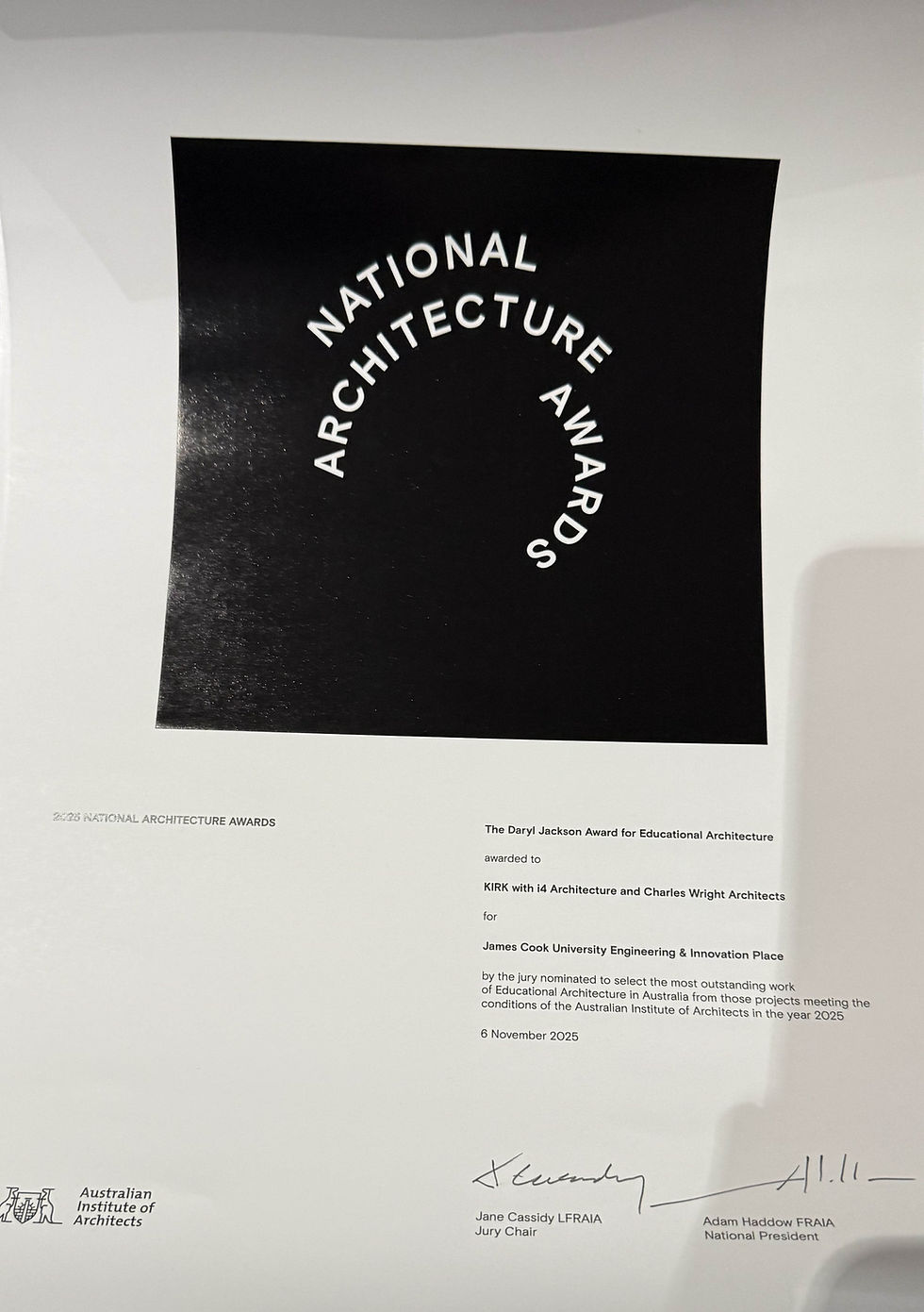
Education & Research: Recipients of the 2025 Daryl Jackson National Award for Educational Architecture for the JCU Engineering & Innovation Place (in Association with KIRK and i4Architecture).
-
Health & Public Infrastructure: Proven delivery of complex medical facilities, including the Kyneton Hospital Redevelopment.
-
Luxury Resorts & Multi-Residential: Pioneers of 6-Star Climate-Positive tourism, including the Wonga Beach Eco-Resort and high-density urban luxury.
-
Sustainable Residential: Winners of the Robin Dods Medal and National Awards for Residential and Sustainable Architecture from the Australian Institute of Architects.
Practice Philosophy: Performance-Driven Design
Established in 2004, CWA has built a national reputation for bold, highly crafted architecture that is both expressive and rigorously resolved—architecture with enduring civic, cultural, and environmental value.
Our approach is defined by four core pillars:
-
Integration of ESD Principles: Ecologically Sustainable Development (ESD) is the fundamental driver of our design process.
-
Strategic Resolution: Expertly balancing construction, financial, and design constraints into cohesive, buildable outcomes.
-
Innovation & Research: Ongoing exploration of site conditions, client objectives, and emerging building technologies.
-
Sense of Place: Creating architecture that captures a strong sense of cultural identity and contemporary expression.
Collaborative Leadership & Technical Delivery
We lead complex projects from early visioning and masterplanning through to detailed documentation and delivery. Our hands-on leadership model ensures continuity of design intent, clear decision-making, and rigorous quality control throughout the life of every project.
The collective experience of our senior leadership team enables CWA to deliver specialist expertise across:
-
Universities & learning environments
-
Cultural institutions and civic infrastructure
-
Healthcare, hospital, and primary health facilities
-
Commercial, workplace, and urban design
-
Hotels, resorts, and destination developments
-
Research facilities and specialist laboratories
Environmental Resilience & Adaptability
Architecture is increasingly shaped by complex climatic and technological challenges. CWA works strategically with clients to embed long-term performance and resilience into every project. Our environmental strategies consider the full building life cycle, including:
-
Carbon performance and embodied energy.
-
Water efficiency, harvesting, and reuse.
-
Passive and active climate control strategies.
-
Renewable energy generation and operational efficiency.
-
Future-proofing for long-term adaptation and change.
As a national practice operating across metropolitan, regional, and remote contexts, Charles Wright Architects is committed to design leadership that is ambitious, enduring, and culturally resonant.
Capabilities & Services
Charles Wright Architects (CWA) provides comprehensive architectural and design leadership across the full project lifecycle, delivering high-performance, complex infrastructure for public, institutional, and private sector clients across Australia.
Our practice is distinguished by the ability to operate confidently within stringent regulatory environments, sensitive cultural and environmental contexts, and live operational sites with demanding delivery frameworks.
Integrated Design Leadership & Technical Services
From strategic visioning through to commissioning and handover, CWA provides integrated lead-consultant services:
Strategic & Visionary
Masterplanning, Urban Design, Strategic Briefing, Feasibility Studies
Engagement & Advisory
Community and Stakeholder Engagement, Procurement Advisory, Development Yield Studies
Technical & Delivery
Project Leadership, Design Management, Specialist Consultant Coordination, Comprehensive Documentation, Construction Phase Services
Interior Architecture
Bespoke Interior Architecture, Commercial Fit-Outs, Hospitality Environments
Specialist Sector Expertise
CWA delivers deep technical and design expertise across a diverse range of project typologies and scales:
Education, Research & Innovation
Universities and Tertiary Education Facilities
Specialist Research Facilities and Laboratories
Vocational Training and New Learning Environments
Healthcare & Public Infrastructure
Hospital Redevelopments and Acute Clinical Facilities
Primary Health Care Centres and Community Infrastructure
Civic Buildings and Cultural Institutions
Luxury Tourism & Destination Development
6-Star Hotels and Climate-Positive Eco-Resorts
Destination Masterplanning
High-Density Urban Luxury and Multi-Residential Precincts
High-Performance Residential
Iconic, Bespoke Residential Architecture
Climate-Responsive and Off-Grid Homes
Resilient Tropical Modernism
Operational Contexts
Operating as a national practice, CWA brings a high-adaptability delivery model to complex environments, including:
Metropolitan Hubs
Navigating high-density planning frameworks, major stakeholder interfaces, and complex approval pathways.
Regional & Remote Contexts
Delivering logistical resilience and climate-specific engineering in Australia’s most demanding geographic and environmental conditions.
OUR TEAM

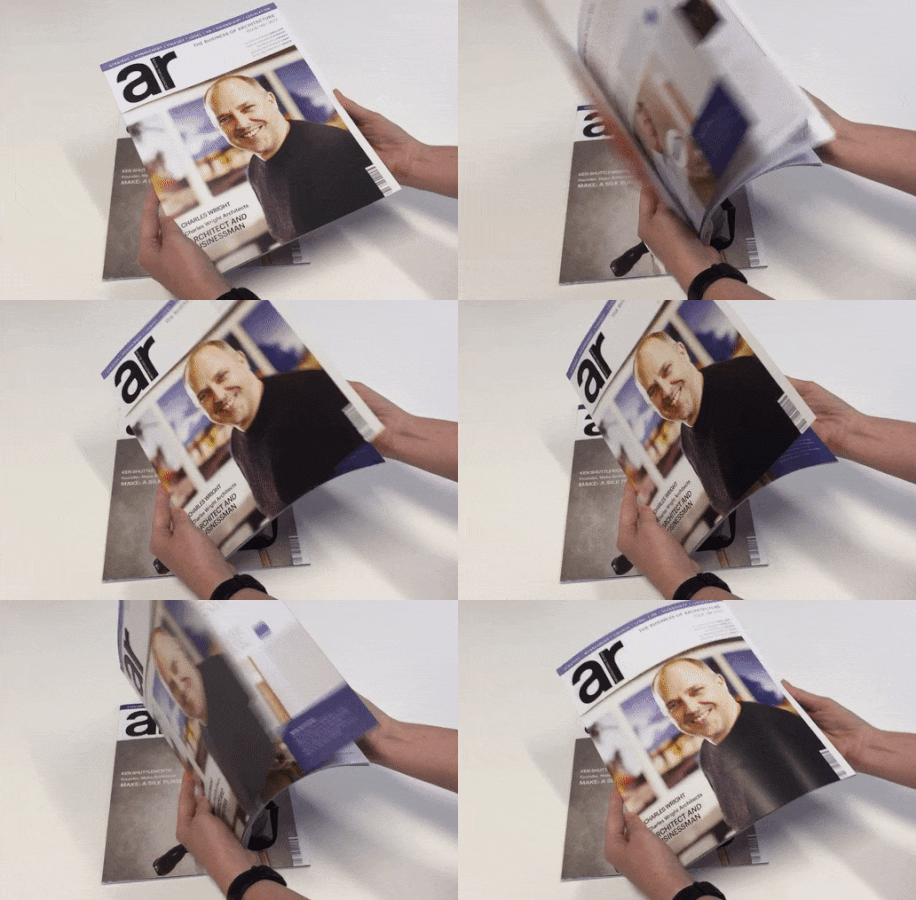
Architectural Review Australia, Issue 148 — editorial feature
FOUNDING DIRECTOR
CHARLES WRIGHT
B.A. (Fine Art), B.Arch (Hons 1st Class), FRAIA
Charles Wright is an Australian Architect and founder of Charles Wright Architects (CWA), an internationally recognised architecture practice with studios in Melbourne and Far North Queensland. The practice delivers residential, cultural, educational, health, commercial, hospitality and tourism architecture across Queensland, New South Wales and Victoria, operating throughout Australia’s eastern seaboard in environments ranging from tropical landscapes and coastal regions to dense metropolitan contexts.
Wright studied Fine Art at RMIT University, specialising in painting and sculpture, prior to undertaking architectural training. This artistic foundation continues to inform the practice’s design approach, where architecture is conceived simultaneously as structure, spatial composition and environmental intervention. Across the studio’s work, structural systems, material expression and landscape integration are developed together to produce buildings that operate both as engineered infrastructure and sculptural architectural form.
Wright’s work demonstrates a rare synthesis of artistic vision, structural innovation and environmental intelligence, aligning with a lineage of polymath architects and the tradition of the “total architect” — the artist–engineer whose practice spans design, engineering and landscape integration — enabling projects to operate seamlessly between sculptural expression, technical rigour and environmental performance.
Across his career Wright has worked at every scale of architecture, from major institutional infrastructure and urban-scale developments to highly experimental bespoke buildings. His early professional experience includes participation in the delivery of major Australian projects such as the BHP Billiton Global Headquarters in Melbourne, the Grace McKellar Centre in Geelong — one of the largest sub-acute and GEM healthcare facilities in Australia, and advanced research facilities including the John Curtin School of Medical Research at the Australian National University in Canberra, globally recognised for cutting-edge biomedical research environments.
This experience established Wright’s capacity to operate confidently within highly complex technical and institutional frameworks — an expertise that continues through CWA’s work delivering university campuses, hospital infrastructure, research facilities and large-scale masterplans.
At the same time Wright’s work has produced some of Australia’s most distinctive contemporary architectural works, including projects such as Stamp House in the Daintree Rainforest, (-)Glass House, The Edge at Port Douglas, and Wilson Beach House (Dicky Beach) — residential works recognised internationally for their sculptural form, climatic responsiveness and environmental integration.
Under Wright’s direct leadership the practice has delivered major cultural and civic projects including the Cairns Botanic Gardens Visitor Centre, as well as internationally recognised educational architecture such as the James Cook University Engineering & Innovation Place, which received the UNESCO Prix Versailles World Title for Educational Architecture (2025).
Wright’s work also extends into large-scale luxury tourism and destination architecture, including the pioneering Wonga Beach Eco-Resort and Byron Bay eco-resort developments, conceived as climate-positive and disaster-resilient tourism infrastructure responding directly to the environmental challenges of the climate era.
The breadth of Wright’s architectural work spans:
• major research and university facilities
• hospital and health infrastructure
• cultural and civic architecture
• commercial and workplace buildings
• high-density luxury multi-residential developments
• destination resorts and hospitality environments
• experimental bespoke residential architecture
Notable urban works include commercial developments such as 17 Cotham Road, Kew, alongside projects within Australia’s highest-value residential districts including Toorak in Melbourne, where Wright has delivered luxury residential and mixed-use developments.
This extraordinary range of project typologies reflects Wright’s rare ability to personally lead projects across vastly different scales and technical domains, from skyscraper-scale institutional works to small experimental houses — a capacity historically associated with the great polymath architects of the discipline.
Through this work Wright has helped develop and articulate the design philosophy of Resilient Tropical Modernism, an architectural approach that integrates structural resilience, environmental intelligence and sculptural form in response to extreme climates and rapidly changing environmental conditions.
Wright’s projects have received extensive international recognition through major architectural awards, global publications and cultural media, and have been featured in leading monographs including publications by Phaidon Press, Thames & Hudson and Images Publishing.
Beyond the architectural profession, Wright’s work has entered global popular culture — most notably when Stamp House was used as a principal filming location in the Hollywood film Godzilla vs Kong — bringing contemporary Australian architecture to a global audience.
Through this body of work, Wright continues to advance architecture as both cultural expression and environmental infrastructure for the climate era, positioning Charles Wright Architects within the global architectural canon.
Design Philosophy
Wright’s architectural philosophy is grounded in the synthesis of art, engineering and environmental intelligence. Projects are developed through the integration of structural innovation, passive environmental systems and spatial composition, producing architecture that responds directly to climate, landscape and cultural context.
This approach aligns Wright’s work with the architectural lineage of the artist–engineer, sometimes described as the tradition of the “total architect,” in which artistic vision, technical innovation and environmental performance are developed as a unified design language. Buildings are frequently conceived as landscape-integrated structures in which architecture emerges as a continuation of terrain, environmental forces and ecological systems.
A defining theme in Wright’s work is the exploration of Resilient Tropical Modernism. Developed through projects in Far North Queensland and other climatically demanding environments, this architectural approach investigates how buildings can respond to extreme weather conditions through robust structural systems, passive environmental strategies and deep integration with landscape. The work explores how architecture can remain expressive and culturally meaningful while addressing the urgent environmental challenges of the contemporary climate era.
Underlying this design approach is an ongoing philosophical interest in the relationship between consciousness, perception and environment. Wright’s architecture often seeks to heighten awareness of landscape, light, material and spatial experience, exploring how built form can influence the way people perceive and inhabit space. In this sense the work engages with broader questions concerning architecture, consciousness and the metaphysics of space, investigating how buildings can mediate between the material and experiential dimensions of the built environment.
The Total Architect
Charles Wright’s work aligns with the historical lineage of architects who operate simultaneously as artists, engineers and environmental thinkers — a tradition often described as the “total architect.”
Within this lineage architecture is understood not as a narrow professional service but as a synthetic discipline integrating:
• spatial composition
• structural innovation
• environmental systems
• material experimentation
• landscape integration
• cultural meaning
This tradition includes figures such as Oscar Niemeyer, John Lautner and Eero Saarinen, architects whose work expanded architecture through the fusion of artistic vision and engineering logic.
Wright’s work continues this lineage within the context of the climate era, where architecture must simultaneously operate as cultural expression, environmental infrastructure and technological system.
Through this synthesis the practice has developed Resilient Tropical Modernism, an architectural approach that responds directly to tropical climates, cyclonic conditions and ecological contexts while maintaining a strong architectural identity and sculptural clarity.
Buildings are conceived as integrated structural landscapes, emerging from terrain and environmental forces rather than being imposed upon them. Passive environmental systems, structural logic and spatial composition are developed simultaneously from the earliest stages of design.
This methodology allows architecture to remain expressive, resilient and culturally meaningful while addressing the urgent environmental challenges of contemporary architecture.
Breadth of Architectural Work
A distinctive characteristic of Charles Wright Architects is the breadth of building typologies delivered under the direct design leadership of its founding architect.
Wright’s work reflects a polymathic approach to architecture, combining artistic practice, structural innovation and environmental research within a unified design philosophy applied across multiple building typologies.
The studio’s work spans:
-
health and medical research facilities
-
education and university buildings
-
cultural and civic architecture
-
residential architecture
-
commercial and mixed-use developments
-
hospitality, tourism and resort architecture
Across these diverse sectors the work maintains a consistent focus on environmental performance, structural clarity and strong architectural expression, reflecting a design methodology that integrates artistic and technical disciplines.
International Recognition and Publications
Projects by Charles Wright Architects have received extensive national and international recognition. The practice has been honoured with major awards from the Australian Institute of Architects and international juries, including the UNESCO Prix Versailles World Title in Architecture.
The studio’s work is widely published in leading international architectural journals and global monographs by publishers including Phaidon Press, Thames & Hudson and Images Publishing, situating the practice’s projects within the broader international discourse on contemporary architecture and climate-responsive design.
Architecture and Global Visual Culture
Several projects by Charles Wright Architects have also entered global visual culture. The practice’s landmark residential project Stamp House, located in the Daintree Rainforest of Far North Queensland, has appeared as a principal filming location in major international productions including the Hollywood film Godzilla vs. Kong. Through this cinematic exposure the architecture has reached a global audience, contributing to its reputation as an iconic example of contemporary tropical architecture with a striking futuristic aesthetic.
National Practice
With studios in Melbourne and Port Douglas, Charles Wright Architects operates across a wide geographic range, delivering projects in tropical, coastal and metropolitan environments throughout Australia’s eastern seaboard. Across these varied conditions the work consistently investigates the relationship between place, climate and culture, producing architecture that responds directly to the environmental and geographic context in which it is located.
Cultural Interests
Beyond architectural practice, Wright maintains long-standing interests in music, philosophy and culinary culture. A jazz saxophonist and amateur chef, he also engages in ongoing philosophical inquiry exploring the relationship between perception, consciousness and spatial experience, interests that continue to inform the conceptual and experiential dimensions of his architectural work.

Strategic Team & Studio Culture
Charles Wright Architects (CWA) operates as a director-led practice supported by a highly skilled, multidisciplinary team of architects, interior designers, technologists, and project delivery specialists. Our collective expertise enables the practice to operate with absolute confidence across metropolitan, regional, and remote contexts, delivering projects of significant scale and technical complexity.
The Director-Led Model: Accountability & Continuity
Every project is led directly by Founding Director Charles Wright. This hands-on leadership model ensures a rare continuity of design intent, clear stakeholder engagement, and absolute accountability from inception through to final delivery. This approach eliminates the "dilution" of vision often found in larger corporate firms, providing our clients with a direct line to the practice’s core intellectual capital.
Technical Depth & Delivery Rigour
Our senior team members bring specialist expertise in Design Development, Technical Coordination, and Construction-Phase Services. We leverage advanced architectural technologies to ensure rigorous delivery across complex procurement environments:
-
BIM & Digital Twins: We utilize advanced Building Information Modelling (BIM) and Revit workflows to manage data-rich projects, ensuring seamless coordination with engineering and specialist consultants.
-
Specialist Sector Knowledge: Our team possesses deep "on-the-ground" experience in Acute Clinical Healthcare, Tertiary Education Facilities, and 6-Star Luxury Tourism infrastructure.
-
Complex Regulatory Navigation: We are experts in navigating the stringent compliance, heritage, and environmental frameworks required for $100M+ public works and sensitive coastal developments.
Collaborative Studio Culture
Our studio culture thrives on a synthesis of diverse perspectives, balancing bold design ambition with buildability, operational performance, and long-term asset value. By operating with integrated consultant teams, we ensure that every project is resolved holistically—technically robust, environmentally resilient, and culturally resonant.


AWARDS
Awards & Recognition
Optimised Awards & Global Recognition
Charles Wright Architects (CWA) is recognized globally for defining the benchmark in climate-responsive and high-performance architecture. Our work is frequently awarded for its rare synthesis of bold sculptural form and rigorous technical performance.
Key Global & National Accolades
-
UNESCO Prix Versailles (International): World Winner Status – Recognized for the World’s Most Beautiful Campus and excellence in Educational Architecture (2025).
-
Australian Institute of Architects (National): Winner of the Daryl Jackson National Award for Educational Architecture and National Awards for Sustainable Architecture.
-
Australian Institute of Architects (State): recipient of the Robin Dods Medal (Residential) and State Awards for Public, Cultural, and the only multiple time recipient of the Jennifer Taylor Medal for Educational Architecture.
-
The Phaidon Atlas: Selected for the Atlas of Brutalist Architecture, canonizing our work alongside the most significant structures of the 20th and 21st centuries.
-
International Architecture Awards: 2014 World Architecture Festival (WAF) - Shortlisted Finalist
Global Media & Cultural Canon
Our projects are featured in the world’s most prestigious architectural monographs by Phaidon Press, Thames & Hudson, and Images Publishing. Beyond the industry, CWA’s work maintains a unique cultural footprint, appearing in global Netflix documentaries and as principal locations for major Hollywood studio productions.
What These ACCOLADES REPRESENT
What Recognition Means for Our Clients
Recognition from UNESCO, the Australian Institute of Architects, and international juries represents more than design excellence; it is independent validation of CWA’s sustained commitment to delivering complex projects through rigorous design, technical resolution, and performance-led outcomes.
For our clients and partners, these awards represent:
Validated Innovation
Independent confirmation that ambitious architectural ideas are grounded in disciplined design development, robust documentation, and technical rigour — and have been assessed by respected national and international juries.
Environmental Performance
National Awards for Sustainable Architecture demonstrate that our climate-responsive strategies are supported by measurable outcomes in carbon reduction, resilience, energy performance, and long-term operational efficiency.
Contextual Intelligence
Recognition across Public, Educational, and Residential sectors reflects our ability to deliver architecture that is both culturally grounded and highly functional across diverse scales and contexts.
Global Benchmarking
Inclusion in international architectural monographs by Phaidon Press and recognition through UNESCO Prix Versailles position our clients’ projects within a global design context — enhancing long-term visibility, institutional prestige, and civic value.
Ultimately, these accolades reflect a practice capable of delivering architecture that is ambitious, technically resolved, and enduringly valued by clients, communities, and the global architectural discourse.


Publications & Media Recognition
Charles Wright Architects’ work is widely published in leading international architectural books and media including Phaidon Press, Thames & Hudson, Images Publishing Group, Architecture Australia, Architectural Review, ArchDaily, Dezeen, Wired and Habitus Living. Projects including the Cairns Botanic Gardens Visitor Centre, Stamp House (Alkira), The Edge, KGB / Wilson Beach House (Dicky Beach) and James Cook University Engineering & Innovation Place have been featured globally for their climate-responsive, sustainable design and innovation.
2008–2025 | Global Canon — International Book Publications
2010 — 21st Century Houses: 150 of the World’s Best — Images Publishing Group — (W)right House
2011 — The New Asia Pacific House — Patrick Bingham-Hall, Pesaro Publishing — (W)right House
2016 — Elemental: Living — Contemporary Houses in Nature — Phaidon Press — Stamp House
2017 — Living in the Landscape — Thames & Hudson Australia — Selected CWA works
2019 — Houses: Extraordinary Living — Phaidon Press — Stamp House
2020 — Atlas of Brutalist Architecture — Phaidon Press — Stamp House
2020 — Monograph on Charles Wright Architects - Patrick Bingham-Hall, Pesaro Publishing
2025 — The Iconic Tropical House — Patrick Bingham-Hall, Thames & Hudson — (W)right House + Stamp House
View Full Publications & Awards Timeline


