


CAIRNS QLD
JAMES COOK UNIVERSITY (JCU) CAIRNS CAMPUS MASTER PLAN
Architects in Association
KIRK with Charles Wright Architects & SASAKI
James Cook University – Cairns Campus Master Plan
Urbanising a Tropical Campus Between Two World Heritage Landscapes
The James Cook University Cairns Campus Master Plan establishes a long-term strategic framework for the evolution of JCU’s 88-hectare Smithfield campus — uniquely positioned between the Wet Tropics of Queensland and the Great Barrier Reef Marine Park.
Developed through multidisciplinary collaboration and extensive stakeholder engagement, the Master Plan redefines the campus as a compact, walkable, interdisciplinary and climate-responsive academic environment capable of supporting long-term growth to 10,000 students.
As local architect within the international master planning team, Charles Wright Architects contributed regional insight, climatic intelligence and contextual calibration to ensure the framework was grounded in the realities of Tropical North Queensland.
From Suburban Campus to Tropical Urban Core
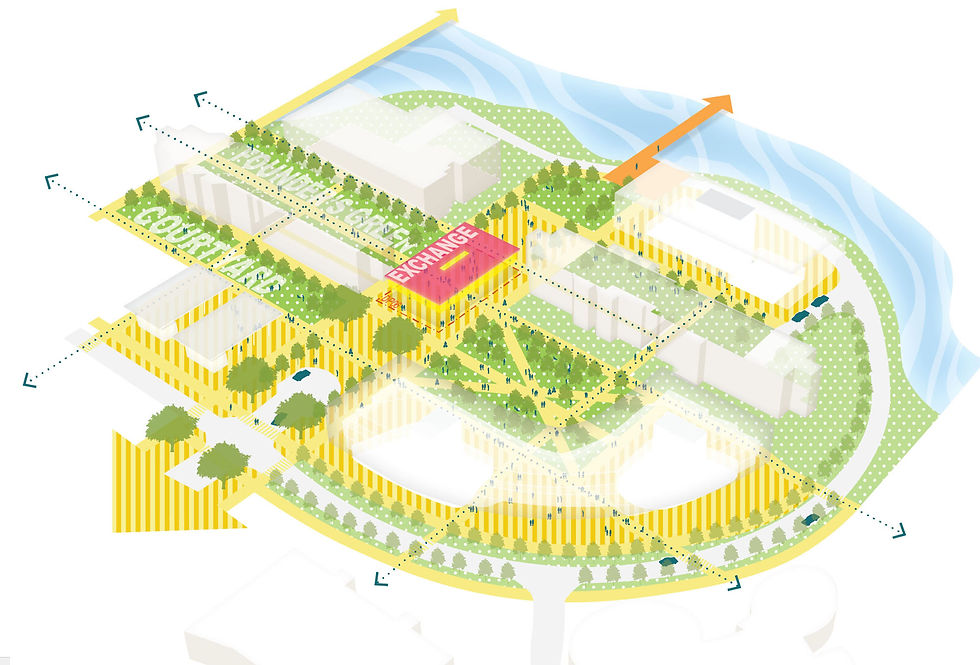
The Master Plan proposes a strategic consolidation of development within the A-Precinct to create a vibrant and activated campus heart. Rather than expanding outward into the rainforest setting, the strategy densifies and reorganises the academic core — reinforcing walkability, reducing heat stress exposure and enhancing interdisciplinary interaction.
A new civic heart — anchored by JCU Square and the Exchange — transforms the central crossroads into a shaded ceremonial and social hub. Surface car parks are progressively consolidated, enabling landscape regeneration and stronger spatial identity.
The result is a transition from dispersed suburban campus to cohesive tropical urban framework.
Tropical Urbanism & Climate Intelligence
Located within a wet tropical climate subject to seasonal monsoonal intensity and cyclonic conditions, the Master Plan integrates advanced microclimate analysis, including Computational Fluid Dynamics modelling, to guide built form orientation and permeability.
Development parcels are structured to:
-
Maintain air movement corridors aligned with prevailing S/SSE winds
-
Limit excessive ground-level site coverage
-
Prioritise shaded ground planes
-
Enhance visual transparency across the campus
Landscape becomes working infrastructure — integrating stormwater management, riparian protection along Atika Creek and increased tropical canopy cover to mitigate heat stress.
Architecture is not imposed on landscape; it is moderated by it.
Interdisciplinary Academic Clusters
The Master Plan responds to evolving pedagogical models by dissolving traditional academic silos and promoting interdisciplinary adjacency. Flexible academic nodes and informal gathering spaces are distributed throughout the campus core to encourage cross-pollination between colleges.
Strategic placement of student accommodation along the ring road reinforces urban density while strengthening passive surveillance, activation and campus life.
The ambition is clear: create a “sticky campus” — socially vibrant, academically integrated and spatially memorable.
Indigenous Engagement & Place Identity
The Master Plan acknowledges the Djabugay, Yirrganygji and Gimuy Yidinji peoples as Traditional Owners of the land and embeds Indigenous engagement as an ongoing design framework rather than a singular gesture.
Rather than prescribing symbolic placement, the plan advocates holistic collaboration across all future development phases — ensuring cultural knowledge becomes embedded within the campus fabric.
Identity is formed through continuous engagement, not applied narrative.
Structured Implementation Framework
The Master Plan is organised through:
-
9 strategic goals
-
5 integrated frameworks
-
50 transformative initiatives
-
Defined development parcels with urban design controls
This structured sequence establishes the document not merely as vision, but as an implementation tool guiding short-, medium- and long-term growth.
A Model for Tropical Academic Urbanism
The JCU Cairns Campus Master Plan 2019 positions the university as a global tropical research institution with a campus form that reflects its geographic identity.
Rather than replicate temperate campus models, the framework advances a distinctly tropical urbanism — dense yet permeable, shaded yet open, civic yet embedded within rainforest landscape.
The project reinforces Charles Wright Architects’ capability in large-scale institutional planning across climate-responsive environments — aligning master planning, urban design and environmental intelligence within a single coherent strategy